Cobh Town
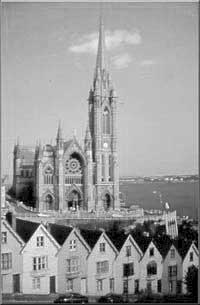
Cobh is a very picturesque town built on a hill side and dominated by St. Colman's Cathedral, which took over 50 years to complete. The Cathedral houses the famous 49 bell Carillon, the largest in Ireland and Britain.
Cove is the earliest name of the town. After the visit of Queen Victoria in 1849 the name was changed to Queenstown. In 1921 after independence the local Urban Council reverted to the old name "Cove" but with the Irish spelling of "Cobh" [the letters bh represent the V sound in Irish].
The harbour and the town has been the the last sight of Ireland for many thousands of emigrants. Over 40 thousand men, women and young girls were transported to Australia from here and millions more left during the famine years for the new world. It was the main transatlantic departure point from Ireland up until the late 1950s.
It was the last port of call for the R.M.S. Titanic on her ill-fated maiden voyage, where she took onboard mail and 123 passengers who were emigrating to the U.S.A..
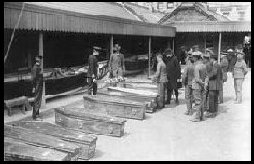
The survivors and most of the victims recovered from the R.M.S. Lusitania torpedoed off the old head of Kinsale were landed in Queenstown, and there are three mass graves in the Old Church graveyard, a mile and a half outside the town where 149 victims are buried.
There are also some private graves, bringing the total number interred there to 169. There are many stories of the survivors' experiences in Queenstown.
The Americans as well as the British were stationed in Queenstown during World War 1.
Cobh is a Heritage Town and attracts many tourists all year round and between 40 and 50 cruise liners call every summer.
There are many other places of interest to visit and things to do in the area. See our links page for more details.